
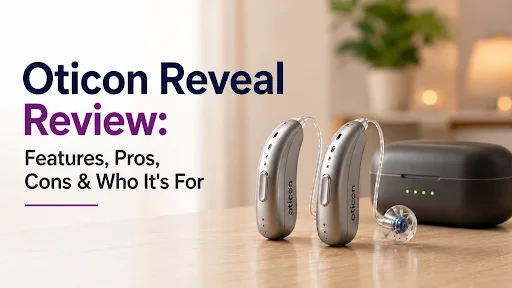
Oticon Reveal Review: Features, Pros, Cons & Who It’s For
If you’re comparing Oticon models, the Reveal is the one that changes the conversation. It’s Oticon’s newest hearing-aid platform, and it does something the brand hasn’t done before: it runs two separate AI systems at the same time.
That sounds like a marketing language. It isn’t.
Hearing aid manufacturers have long split into two camps. One narrows hard on speech and pushes everything else down. The other keeps your sound environment open so the world still feels real. Oticon has always sat in the second camp and it’s cost them, because in a loud restaurant the narrowing approach often wins.
Reveal is Oticon’s answer to that trade-off. Rather than picking a side, it runs a Speech AI and a Context AI together, always on, both designed to adapt in real time across changing listening environments.
Summary
Oticon Reveal is a rechargeable miniRITE hearing aid built on the Reveal AI platform, the first to use a Dual AI system combining dedicated Speech AI and Context AI. Oticon reports up to 25 dB more available gain than three top competitors, based on its own technical testing, 4D Sensor technology that responds to your listening intent, and Wind & Handling Stabilizer 2.0 delivering up to 40 dB of wind and handling noise reduction. It connects directly to iPhone, iPad and Android, with a matching Oticon CROS RE for single-sided deafness. The strongest evidence behind it is Oticon’s own worth knowing as you compare.
Key Takeaways
- First hearing aid to run two AI systems simultaneously Speech AI and Context AI
- Up to 25 dB more available gain than three top competitors, per Oticon
- Wind & Handling Stabilizer 2.0 gives up to 40 dB attenuation, around 10 dB more than before
- 4D Sensor technology adapts to what you’re trying to hear, not just where you are
- Oticon reports 53% better streaming stability and up to 32% greater range compared with Oticon Intent
- Oticon CROS RE pairs with Reveal for single-sided deafness
- Most performance claims are Oticon’s own research, so trial before deciding
What Oticon Reveal Actually Does Differently
Speech AI handles the voice you’re trying to follow. Context AI handles everything else: the room, the footsteps, the car approaching from your left. Both run continuously rather than one handing off to the other.
Why does that matter? The moment a hearing aid prioritizes speech, it sacrifices something. You get clearer conversation and a flatter world around it. Plenty of wearers describe listening through a tunnel. It’s clear, but it isn’t natural, and it’s tiring over a full day.
Running both at once keeps the clarity without flattening the rest. Whether you notice depends on how much time you spend in complex environments.
The Features Worth Understanding
More Available Gain and Why That’s Not Just a Number
Oticon reports up to 25 dB more available gain than three top competitors, achieved through new feedback prevention.
Here’s what that means in a fitting room. Feedback is that whistle you sometimes hear from a hearing aid, and it’s why many devices get fitted more conservatively than they should be. Better feedback control lets your audiologist give you the amplification your hearing loss actually calls for, with a more open fitting.
If you’ve been told you can’t have an open dome because of feedback, or your aids whistle when you hug someone or put on a hat, this is the specification that matters most to you.
4D Sensor Technology
Reveal also uses Oticon’s 4D Sensor technology, which was introduced with Oticon Intent. The system incorporates information from head and body movement, conversation activity and the acoustic environment to personalize how the hearing aids respond to your listening needs.
Wind & Handling Stabilizer 2.0
Up to 40 dB of wind and handling noise attenuation roughly 10 dB more than the first-generation system. Handling noise is the underrated half: the scrape you hear adjusting your glasses, brushing your hair back, pulling a hood up. People who spend significant time outdoors or frequently handle their hearing aids are more likely to notice the difference.
Connectivity and Streaming
Reveal connects directly to iPhone, iPad and Android. Oticon reports 53% better streaming stability and up to 32% greater range compared with Oticon Intent. Range is the practical win the difference between audio dropping when you walk to the kitchen and it holding steady across the house.
Rechargeable Power and CROS Option
Reveal is rechargeable in a compact miniRITE housing. There’s also the Oticon CROS RE, the first CROS device with Dual AI routing sound from an unaidable ear across to a Reveal on your better ear.
Pros
- Genuinely new architecture, not an incremental refresh
- More available gain, widening fitting options
- Strong wind and handling noise control
- Better streaming range and stability than the previous generation
- Discreet rechargeable miniRITE form factor
- CROS solution for single-sided deafness
Cons
I’d rather you hear this from us than discover it later.
- The evidence is largely in-house. The performance figures come from Oticon’s own research. That’s normal in this industry and doesn’t mean they’re wrong, but they haven’t been independently replicated, and “up to” is doing real work in several of them.
- The competitor comparisons are unnamed. Claims measured against “three top competitors” don’t say which three, or which technology tiers.
- One key stat compares Oticon to Oticon. That 94% of users prefer Reveal over Oticon Intent is useful if you’re deciding between those two. It says nothing about Signia, Phonak, ReSound, Widex or Starkey.
- New platforms take time to settle. Accessory availability and fitting-software maturity usually improve over a release’s first year.
- Battery runtime varies. Real-world use depends on your hearing loss, streaming habits, active features and battery age.
Who Oticon Reveal Is For
Reveal makes most sense if you spend real time in complex, changing environments, open-plan offices, restaurants, family gatherings, and busy streets. It’s a strong fit if you’ve been frustrated by hearing aids that make speech clear but the world flat, or if feedback has limited your fittings before. Outdoor and active wearers benefit most from the wind and handling improvements. With single-sided deafness, ask about CROS RE specifically.
It’s less compelling if your days are quiet and predictable, if you already wear well-fitted Oticon Intent devices and hear comfortably, or if you’d rather buy into a platform with a longer track record. None of those rule it out they’re reasons to trial rather than commit on paper.
Conclusion
Oticon Reveal is the most interesting thing the brand has released in years, and the Dual AI architecture is a real engineering shift rather than a renamed version of what came before. Running speech and context processing simultaneously addresses a genuine weakness in how hearing aids have traditionally worked, and the jump in available gain quietly gives your audiologist more room to fit you properly which often matters more to daily comfort than any headline feature.
That said, the supporting evidence is currently Oticon’s own, the competitor comparisons are unnamed, and the most striking preference statistic measures Reveal against another Oticon device. None of that makes it a weak product. It makes it one you should judge on your own ears rather than on a specification sheet, in the rooms where your hearing actually gives you trouble. If Reveal delivers the way the research suggests, you’ll know within a few days of wearing it and if it doesn’t, you’ll know just as quickly.
Visit earsolutions.us to book a hearing test or arrange an Oticon Reveal trial at one of our centers across New York, Massachusetts and Connecticut.
FAQs
What makes Oticon Reveal different from other hearing aids?
Reveal is the first hearing aid to run a Dual AI system, a dedicated Speech AI and a separate Context AI operating simultaneously. Most hearing aids prioritize speech at the expense of surrounding sound. Reveal aims to deliver both in balance rather than trading one against the other.
Is Oticon Reveal better than Oticon Intent?
Oticon reports 94% of hearing aid users prefer Reveal over Intent, and Reveal adds Dual AI, more available gain and improved streaming range. Whether it’s better for you depends on your hearing loss and environment. If your Intent devices are well-fitted and working, an upgrade may not be necessary.
Is Oticon Reveal good for wind noise?
It’s one of its stronger features. Wind & Handling Stabilizer 2.0 provides up to 40 dB attenuation of wind and handling noise, around 10 dB more than the first-generation system. That covers both outdoor wind and the noise created when you touch your glasses, hair or hat.
Is there an Oticon Reveal option for single-sided deafness?
Yes. Oticon CROS RE is the first CROS device with Dual AI and pairs with Reveal. It picks up sound from an ear that can’t be helped by amplification and sends it to the hearing aid on your better ear, so you stop missing people seated on your weaker side.
Should I book a hearing test before choosing Reveal?
Yes. A current audiogram, including speech testing in noise, determines whether Reveal suits your hearing loss and which technology level fits. Sudden hearing loss in one ear, ear pain, drainage or dizziness needs prompt medical attention rather than a hearing aid appointment.
-
Tags :
- affordable hearing aids
- Best Bluetooth Hearing Aid Brands
- best hearing aid brands in the USA
- best hearing aids 2026
- buy hearing aids online
- Buying Hearing Aids
- comparison
- comparisons
- digital hearing aids
- hearing aid
- hearing aid clinic near me
- hearing aid prices
- hearing aid shop
- hearing aids
- Hearing aids cost
- hearing center in New York
- modern hearing aids
- Oticon Intent hearing aid
- shop hearing aids


