
A Guide to Behind-the-Ear Hearing Aids and How They Work?
Table of Contents
Summary
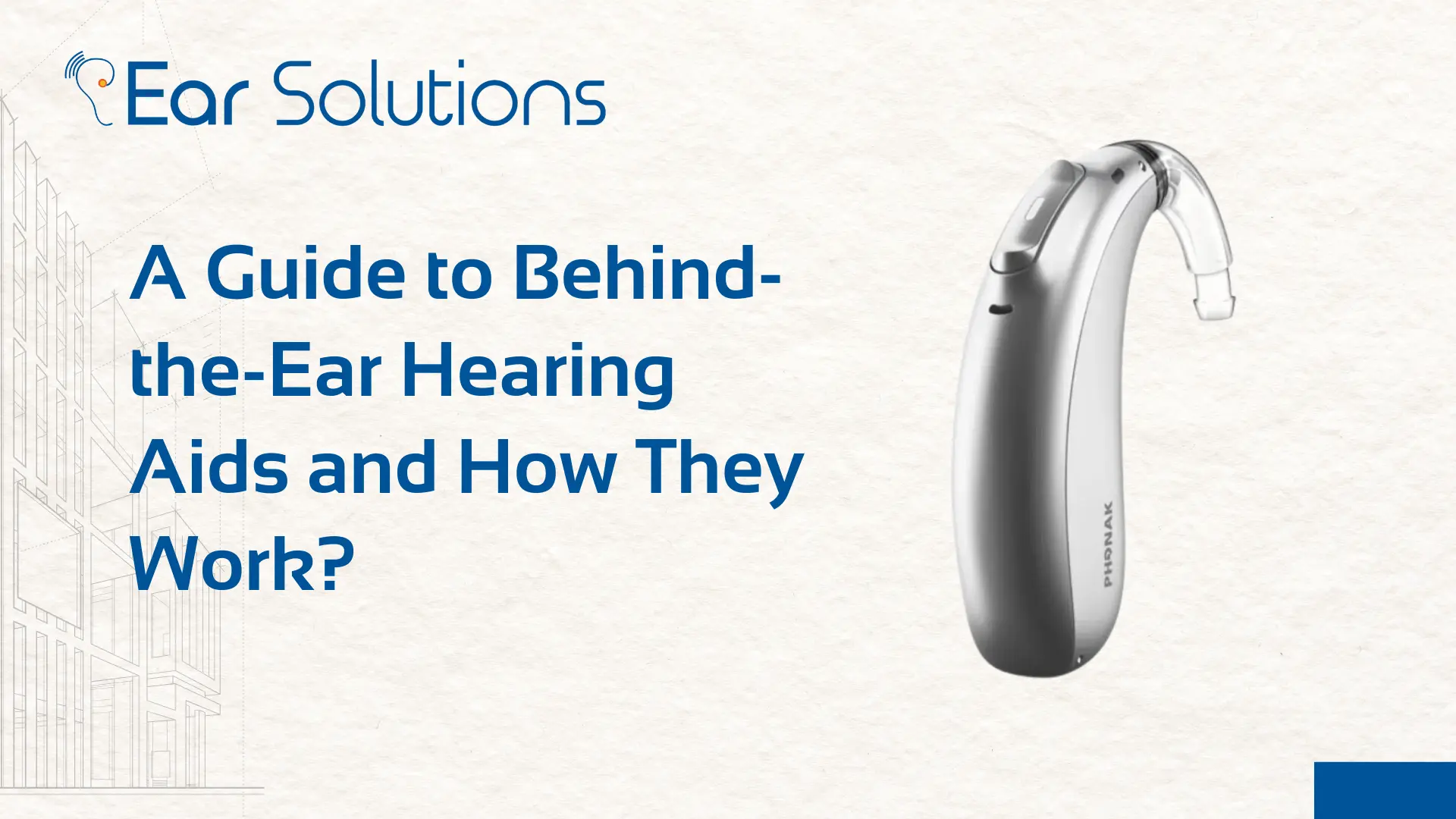
A hearing machine worn behind the ear is placed behind the outer ear and linked to the ear canal via a thin tube or a custom earmold. Such a configuration permits the device to contain powerful parts while still being comfortable. How is a professional hearing test important for the right hearing aid, and what will be the process for it?
Key takeaways
Behind-the-ear hearing machines have changed drastically over time. Initial devices were large and very noticeable, but present-day models are elegant, lightweight, and hardly noticeable.
In this blog, you are going to understand what a behind-the-ear hearing aid is, how behind-the-ear hearing aids work, and how they work. How they have changed the world of hearing aids. These machines are available for all stages of hearing loss and people willing to use them.
Introduction
Behind-the-ear hearing machines can be used by those who have mild, moderate, severe, or even profound hearing loss, which is why they are among the most versatile hearing aid options on the market today.
History of Behind-the-Ear Hearing Aid Technology
Behind-the-ear hearing aids have changed drastically over time. Initial devices were large and very noticeable, but present-day models are elegant, lightweight, and hardly noticeable. The incorporation of digital processing, wireless communication, and energy storage advancements has turned present- day behind-the-ear hearing devices that are not only more efficient and reliable but also easier to use than ever before
Key Components of a Behind-the-Ear Hearing Aid
A behind-the-ear hearing aid has several essential components of many important working together. The microphone catches the sound from the surrounding environment, while on the other hand, the digital processor analyses and increases the sound signals. The amplifier increases the strength of these signals, and the receiver delivers processed sound into the ear canal. Each of these parts has its own role to ensure a clear and natural sound throughout the function of work.
Step-by-Step Explanation of How a Behind-the-Ear Hearing Aid Works
First of all, the microphone collects the sound waves coming from the surroundings. After that, the sound waves are changed into digital signals and transmitted to the processor of the hearing aid. The processor separates the voice from other sounds for evaluation, then it improves the voice while reducing the noise. After that, the sound is amplified and sent to the ear through a speaker. This way, the brain can quickly understand the sounds, which significantly improves hearing.
Digital Sound Processing Makes Speech More Understandable
The latest behind-the-ear hearing aids come with digital sound processing features that significantly improve speech understanding. The computer program makes the speech patterns distinguishable and separates them from the background noise. As a result, even in challenging listening situations like a noisy restaurant or outdoors, the users will find the conversation clearer. This is a wonderful feature of people who have problems with speech comprehension, not just the volume.
Directional Microphones and Noise Cancellation Technology
The directional microphones found in most Behind-the-Fan/Rear Mic Hearing Adapter units are designed to capture audio coming from the front of the user while cancelling out noise coming from any other direction. Directional microphone technology combined with noise cancellation algorithms allows users to be part of the conversation without being overwhelmed by surrounding noise, which makes everyday interactions much more pleasant and much less exhausting.
Automatic Sound Modulation for Different Environmental Conditions
Most BTE Hearing Adapters (BA) have been created specifically to adjust automatically to changing environmental conditions. Regardless if you have moved from one very quiet environment (like a library) into a very loud and crowded environment (such as a city street), BTE Hearing Adapters will compensate for any type of environmental change in an instant. Automatic adjustment capabilities mean that sound quality is still the same at all times without needing to be manually adjusted, providing the user with one continuous listening experience throughout an entire day.
The Importance of a Hearing Test Before Choosing a Hearing Aid
A professional hearing test is important for understanding the type and condition of hearing loss you have. At the time of the hearing test, different sound frequencies and speech levels are analysed to create a detailed hearing profile. This information is essential for professionals to program the behind-the-ear hearing aid with this as per the individual’s needs without any type of hearing tests; a hearing aid can not deliver good performance and comfort.
Personalised Programming of a Hearing Aid
After the Hearing TestAfter a hearing test, the hearing aid is set up to meet the user’s hearing profile. This tailored programming guarantees that quiet sounds become audible, speech is understandable, and loud sounds stay comfortable. Hearing aids behind the ear (BTE) can be reprogrammed as the hearing changes, thus they are a solution for hearing loss over the long term.
Comfort and Fit of BTE Hearing Aids
Comfort is one of the most important factors in using a hearing aid. BTE hearing aids are made to rest comfortably behind the ear, and less pressure is felt inside the ear canal. The use of custom earmolds or soft ear tips can further help with fitting and comfort, which means the hearing aid can be worn for longer periods without any skin irritation. This is why such hearing aids can be worn and are suitable for use every day, all day long.
Ease of Use and Maintenance
Hearing aids behind the ear are more user-friendly than smaller types simply because of their size and the fact that they are worn outside. This is a great advantage for older people or those with limited hand skills. Besides that, the cleaning and caring process is easier too, which means the devices are kept clean and are more durable.
Key Advanced Features in Modern BTE Hearing Aids:
Real-Time AI & Deep Neural Networks (DNNs):
Besides the traditional hearing aid functionalities, these BTEs come with an AI feature that is capable of distinguishing speech from noise, thus providing a signal-to-noise ratio enhancement of up to 15-DB On the other hand, Phonak Sphere Infinia employs separate processors for performing AI sound processing, pointing to an on-device capacity for real-time AI.
Superior Connectivity:
Direct streaming of phone calls, music, and TV from smartphones and tablets without any hassle.
Advanced Directional Microphones:
These microphones automatically pinpoint speech’s direction and focus on it while cutting down noise from other directions.
Rechargeable Technology:
Offers long-lasting power, with some models providing up to 37 hours of battery life on a single charge.
Tinnitus Management:
Various sound therapy options integrated can produce personalised tranquil sounds to help cover the tinnitus.
Durable & Flexible Design:
A larger casing is less vulnerable to moisture and wax damage and can accommodate different tubing and earmold options.
Remote Adjustments & Control:
If users wish to, they can change the noise settings via apps, and some models can even be AI-assisted for real-time adjustments.
Conclusion
BTE (behind-the-ear) auditory assistance devices are extremely popular today due to their endless versatility. Thanks to powerful new electronics, BTE devices can be prescribed for hearing losses from slight to profound and fit comfortably behind the ear hearing aids. Because modern BTEs are designed to adapt to different acoustic environments, they are suitable for use in several situations throughout the day, even when multiple age groups are involved.
The advancements in digital processing, directional microphones, noise cancellation through artificial intelligence (AI), and seamless wireless connections with current BTE devices have changed the role of BTEs from simple amplifiers to also enhancing an individual’s ability to perceive/sense speech, improving real-life communication, understanding speech better than ever before, and ultimately enhancing the recipient’s overall quality of life.
FAQs
What kind of hearing aid is a behind-the-ear (BTE) model?
A behind-the-ear (BTE) hearing aid is a type of hearing instrument that is placed behind the outer ear. It is connected to the ear canal either through a thin tube or a custom earmold.
For which people are BTE hearing aids suitable?
BTE hearing aids cater to the hearing needs of individuals with mild, moderate, severe, or even profound hearing loss. Because of the adaptability and strength of these devices, they are generally recommended for children, adults, and seniors.
What is the principle behind a behind-the-ear hearing aid?
Essentially, a BTE hearing aid works by first receiving sound through a microphone that converts it to digital signals and then processes it to enhance speech and reduce noise simultaneously.
Do behind-the-ear hearing aids feel good on the ears?
Definitely, today’s BTE hearing aids are made with considerations for them to be very light, ergonomic, and comfortable. As the main gadget is placed behind the ear, there is less force put inside the ear canal.
Are BTE hearing aids inherently more powerful than other types?
In most cases, BTE hearing aids can accommodate larger amplifiers and batteries, hence benefiting individuals with a broader spectrum of hearing loss, including severe or profound levels.
