
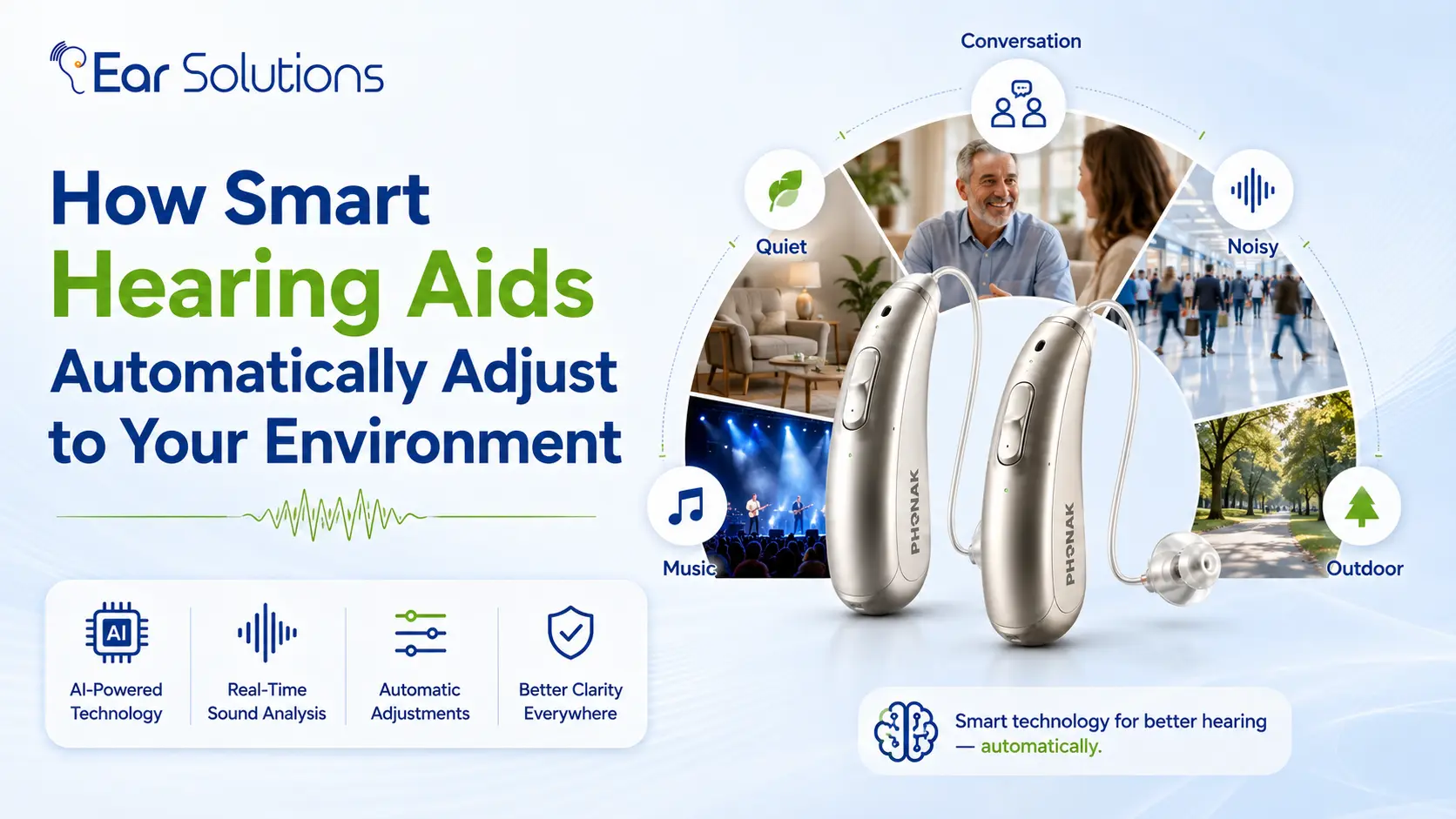
How Smart Hearing Aids Automatically Adjust to Your Environment
Most people assume a hearing aid is a simple volume control. You put it in, sounds get louder, and that is the end of the story. Anyone who has actually lived with hearing loss knows that is not how it works. Loud is not the same as clear. More sound is not the same as better sound. And a device that simply amplifies everything around you equally is not solving the problem. It is just making the problem noisier.
That gap between what people expect from hearing machines and what they actually need is exactly what modern AI hearing devices are designed to close.
Summary
Smart hearing aids in 2026 use artificial intelligence, automatic environment detection, and Bluetooth connectivity to adapt to your surroundings without any manual input. For people with hearing problems, this means moving through a full day of varied environments without constantly adjusting settings or struggling to follow conversations. AI hearing machines and Bluetooth hearing aids together represent the biggest shift in hearing care in a generation, and understanding how they work helps you make a more informed decision about your own hearing health.
Key Takeaways
- Modern AI hearing devices automatically detect and adapt to over 200 different sound environments without manual switching.
- Bluetooth hearing machines connect directly to smartphones, televisions, and other devices for seamless audio streaming.
- AI-driven noise reduction separates speech from background noise rather than simply reducing overall volume.
- Smart hearing devices reduce listening fatigue significantly, which is one of the most underreported effects of unmanaged hearing loss.
- A proper fitting at a certified clinic remains essential even for the most advanced AI hearing aids available today.
Why People With Hearing Loss Need More Than Just Amplification
A hearing problem is not a single experience. It affects different frequencies differently, varies between ears, and changes depending on the environment you are in. Someone with a moderate hearing issue in a quiet room might manage reasonably well. Put that same person in a busy restaurant, a family gathering, or a noisy office, and the experience becomes genuinely exhausting.
The brain works overtime trying to fill in missing sounds, interpret partial words, and follow multiple voices at once. This is called listening fatigue, and it is one of the most common and least discussed effects of hearing loss. People come home from a normal working day feeling drained, not because of what they did but because of how hard their brains worked just to follow conversations.
Traditional hearing machines helped with this, but not enough. They made things louder without always making them clearer, and they required constant manual adjustment as environments changed throughout the day. AI hearing aids changed that equation completely.
Here is the updated section to insert after the “What Bluetooth Hearing Aids Add to the Experience” heading:
Leading AI and Bluetooth Hearing Aids Available in 2026
Some of the most recommended AI and Bluetooth hearing aids in 2026 include the Phonak Sphere Infinio, Oticon Intent, Signia Integrated Xperience, Starkey Genesis AI, ReSound Nexia, and Widex Moment Sheer. Each of these devices offers automatic environment adaptation, direct Bluetooth streaming, and companion app control, though they differ in their processing approach, accessory ecosystems, and standout features. Your audiologist will help identify which platform suits your specific audiogram and lifestyle best.
AI and Bluetooth Hearing Aids Comparison Table
| Feature | Phonak Sphere Infinio | Oticon Intent | Signia Integrated Xperience | Starkey Genesis AI | ReSound Nexia | Widex Moment Sheer |
|---|---|---|---|---|---|---|
|
AI Processing |
Infinio Chip + Sphere AI |
Deep Neural Network |
Augmented Xperience |
Edge AI Chip |
Organic Hearing AI |
SoundSense AI |
|
Bluetooth Connectivity |
Android + iPhone
|
Android + iPhone |
Android + iPhone
|
Android + iPhone |
Android + iPhone |
Android + iPhone |
|
Auto Environment Detection |
AutoSense OS 5.0
|
MoreSound Intelligence 3.0
|
Auto EarStream
|
Neuro Sound Technology
|
Environment Optimizer
|
SoundSense Learn
|
|
Health Monitoring
|
No |
No |
No |
Yes (Fall Detection, Activity Tracking)
|
No |
No |
|
Own Voice Processing
|
No |
No |
Yes (OVP)
|
No |
No |
No |
|
Rechargeable Option |
Yes
|
Yes
|
Yes
|
Yes
|
Yes
|
Yes
|
|
Companion App
|
myPhonak |
Oticon ON
|
Signia App
|
Thrive |
ReSound Smart 3D
|
Widex Moment App
|
|
Best For
|
Noisy environments, AutoAdapt
|
Listening fatigue, natural sound |
First-time users, voice comfort
|
Seniors, health tracking
|
Natural sound, iPhone users
|
Audiophiles, musicians
|
How AI Hearing Aids Detect and Adapt to Your Environment
The core of a modern AI hearing aid is an onboard chip that processes sound thousands of times per second. As you move through your day, the hearing aid is continuously analysing the acoustic environment around you. Is there background noise? Is it speech or non-speech noise? How many voices are present? How much reverberation is in the room? What direction is the primary sound coming from?
Based on those analyses, the hearing aid shifts its processing profile automatically. In a quiet room, it opens up to let natural sound through. In a noisy restaurant,it focuses on speech and pulls back on background clutter. On a phone call,it switches to a mode optimised for voice clarity. On a walk outside, it manages wind noise without cutting out the sounds you actually want to hear.
All of this happens without you touching anything. For someone with hearing loss who has spent years constantly managing their device, this automatic adaptation is the feature that changes daily life most noticeably.
What Bluetooth Hearing Aids Add to the Experience
Bluetooth hearing aids take the smart hearing aid experience a step further by connecting your hearing device directly to the technology you already use every day. Your smartphone, your television, your laptop, and even your car audio system can all stream sound directly into your hearing aids without any wires or intermediate devices.
For someone with hearing loss, this is genuinely transformative. Phone calls come through clearly because the audio bypasses the room entirely and goes straight to your ears. Watching television no longer means turning the volume up to a level that bothers everyone else in the room. Video calls, music, navigation directions, and work meetings all arrive with the same clarity.
Modern Bluetooth hearing aids also connect to companion apps on your smartphone. Through the app, you can adjust volume, switch programs manually if you prefer, check battery levels, and even share your hearing settings remotely with your audiologist for fine-tuning without an in-clinic visit. The level of control available is genuinely impressive, but the point is that you rarely need to use it because the automatic systems handle most situations on their own. So, are modern hearing aids worth it? For many people, the convenience and improved hearing experience make them well worth considering.
How Smart Hearing Aids Reduce Listening Fatigue
One of the most significant and underappreciated benefits of AI hearing aids is the reduction in listening fatigue. When a hearing aid is doing the cognitive heavy lifting, your brain does not have to. Sounds arrive organised, speech is separated from noise, and your auditory system is not constantly working to reconstruct missing information.
People who switch from older hearing aids to current AI hearing aids consistently report that they feel less tired at the end of the day. They stay in conversations longer. They stop avoiding social situations that previously felt overwhelming. These are not minor quality-of-life improvements. For many people with hearing loss, they represent a return to a version of daily life they had quietly given up on.
Why Proper Fitting Still Matters With AI Hearing Aids
The technology inside modern AI hearing aids and Bluetooth hearing aids is remarkable, but it does not work the same way in every ear. The automatic environment detection systems are calibrated during the fitting process based on your specific audiogram. Real-ear measurement ensures that what the hearing aid delivers at the eardrum matches what your hearing profile actually requires.
A premium AI hearing aid that has not been properly fitted will underperform consistently. The automatic adjustments will be based on incorrect baseline settings, and the result will be a device that works reasonably but never quite as well as it should. The fitting appointment is not a formality. It is the step that determines whether everything else performs the way it was designed to.
Conclusion
Hearing loss affects hundreds of millions of people worldwide, and for a long time, the solutions available did not keep up with what people actually needed. AI hearing aids and Bluetooth hearing aids in 2026 have genuinely closed that gap. The technology adapts to your environment, connects to your world, reduces fatigue, and gives you back the effortless hearing that hearing loss takes away.
If you have been living with hearing loss and putting off the decision, the devices available today are meaningfully better than anything that existed even three years ago. Book a free hearing assessment at Ear Solutions, speak to an audiologist who works with the full range of AI hearing aids available in the market, and find out what the right device looks like for your specific hearing profile.
FAQ
What are AI hearing aids,and how do they work?
AI hearing aids use artificial intelligence and advanced on-board chips to continuously analyse your sound environment and automatically adjust their processing to suit it. They detect whether you are in a quiet room, a noisy restaurant, or outdoors and shift their settings without any manual input from you.
What is the difference between regular hearing aids and Bluetooth hearing aids?
Bluetooth hearing aids include wireless connectivity that allows them to stream audio directly from smartphones, televisions, laptops, and other devices. Regular hearing aids amplify surrounding sound but do not connect to external devices. Bluetooth hearing aids offer a significantly more connected and convenient experience.
Can AI hearing aids really reduce listening fatigue?
Yes. Because AI hearing aids organise incoming sound and separate speech from background noise automatically, the brain does not have to work as hard to process what it hears. Most users who switch to AI hearing aids from older models report noticeably less tiredness at the end of the day.
Do I still need to visit a clinic if I buy AI hearing aids?
Yes. Even the most advanced AI hearing aids must be fitted by a qualified audiologist using real-ear measurement based on your specific audiogram. Without a proper fitting, the automatic systems are working from an incorrect baseline setting, gs and the device will underperform.
Where can I try AI hearing aids and Bluetooth hearing aids in the USA?
Ear Solutions clinics across the USA carry the full range of leading AI hearing aids and Bluetooth hearing aids. Every consultation includes a free hearing assessment, a thorough audiological evaluation, and expert fitting and aftercare support.
-
Tags :
- affordable hearing aids
- AI Hearing Aids
- best hearing aid 2026
- best hearing aids in the USA
- bluetooth hearing aids
- Buying Hearing Aids
- digital hearing aids
- free hearing test online
- hearing aid
- hearing aid clinic
- hearing aid features
- hearing aid prices
- hearing aid shop
- hearing aid shop near me
- hearing aids near me
- hearing loss
- Invisible Hearing Aids
- smart hearing aids


