
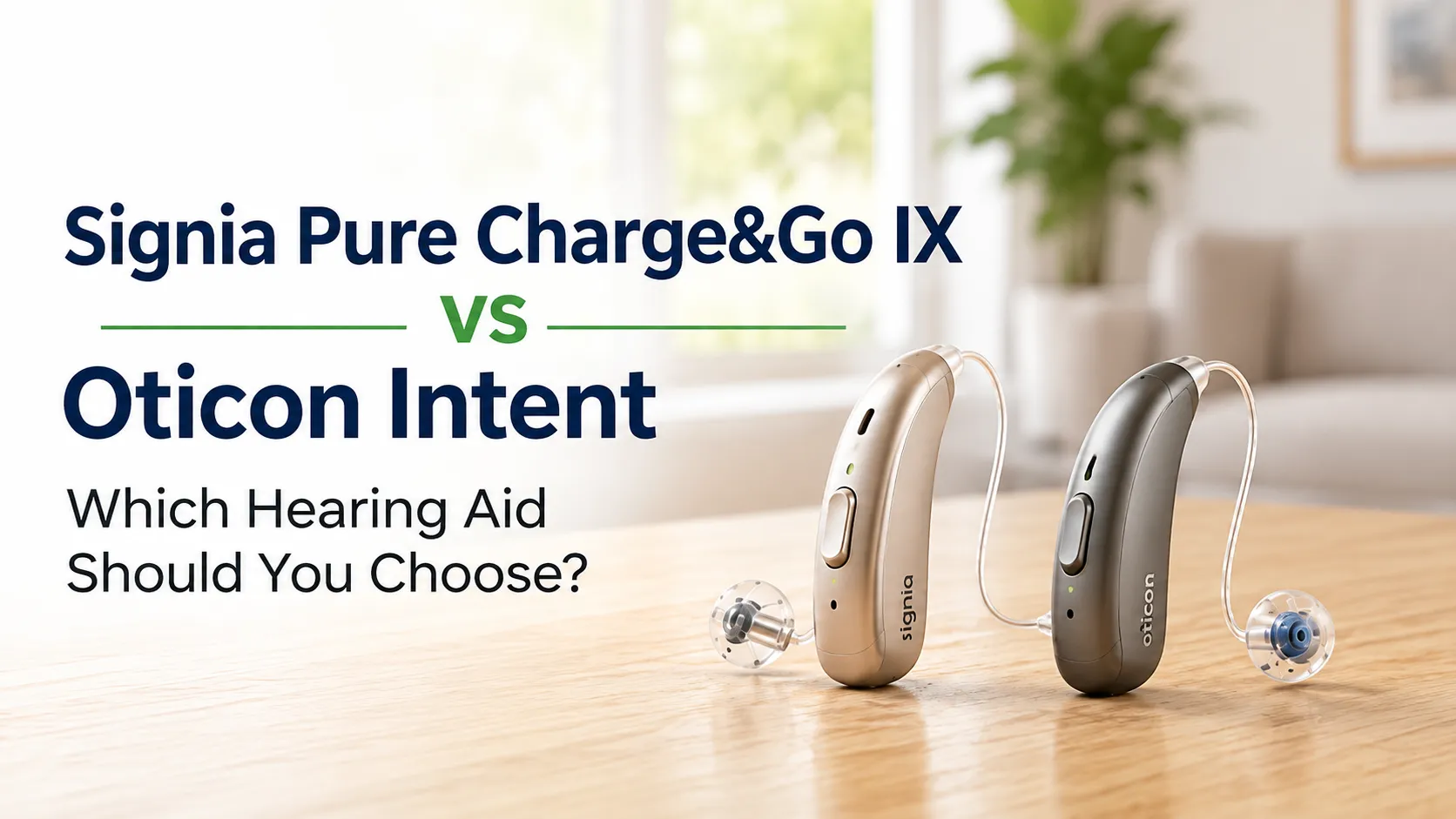
Signia Pure Charge&Go IX vs Oticon Intent: Which Hearing Aid Should You Choose?
Choosing between the Signia Pure Charge&Go IX and Oticon Intent isn’t simply about picking the hearing aid with the longer feature list. Both are designed for mild to severe hearing loss, but they approach everyday listening differently. Signia focuses on making speech stand out from background noise, while Oticon Intent is designed to understand your listening situation and respond to what you’re trying to hear.
With prices starting at $1,449 per device for Signia at Ear Solutions and $1,549 for Oticon Intent, the difference comes down to more than cost. In this guide, we’ll compare how each hearing aid performs in real-world situations, including conversations, noisy environments, comfort, battery life, features, and overall value.
Summary
Signia Pure Charge&Go IX vs Oticon Intent comes down to two different approaches to sound. Signia uses its processing technology to separate and enhance speech against surrounding noise, while Oticon Intent uses sensors to assess movement, conversation, and the listening environment to determine what you are likely trying to hear.
In practical terms, Signia may appeal more if speech clarity and noise separation are your priorities, while Oticon Intent may suit you if you want the hearing aid to adapt more dynamically to changing listening situations. Signia starts at $1,449 per device at Ear Solutions, compared with $1,549 for Oticon Intent, with different technology levels available.
Key Takeaways
- Signia Pure Charge&Go IX sharpens the contrast between speech and background noise
- Oticon Intent uses movement sensors to follow where your attention is going
- Signia starts from $1,449 per device; Oticon Intent from $1,549 per device
- These are per-device prices most people need two
- Both come in multiple technology levels, so cost can match your listening needs
- Signia offers a telecoil version; Oticon Intent does not
- Both are rechargeable, IP68 rated and adjustable remotely through an app
- The right choice depends on your hearing test, lifestyle, comfort and budget
Signia Pure Charge&Go IX: Making the Voice Stand Out
Signia calls its approach Augmented Focus. Instead of pushing all sound down one pathway, it runs two processing streams one following the person you’re focused on, one following the room then blends them back together.
The goal is contrast, not volume. Your brain doesn’t understand speech better just because it’s louder. It understands speech better when the gap between voice and background widens. That’s the whole idea here.
There’s also Own Voice Processing 2.0, and I’d argue it’s underrated. New wearers are often surprised by how strange their own voice sounds in the first few weeks, hollow, not quite right. It’s one of the most common reasons people quietly stop wearing hearing aids in month one. Signia treats it as its own processing task rather than hoping you’ll adjust.
Battery runs up to 36 hours, including 5 hours of streaming, so most wearers get two days per charge. A telecoil version is available, which matters if your theater or place of worship still runs a hearing loop.
Best for: People whose hardest moments are group conversations and busy restaurants, first-time wearers worried about their own voice, and anyone needing telecoil.
Oticon Intent: Working Out What You're Trying to Hear
Oticon went in a different direction. The Intent uses 4D Sensor technology, pulling in four kinds of information at once: head movement, body movement, whether you’re talking or listening, and the sound environment.
Think about how you listen when no device is involved. You turn toward a voice. You lean in slightly. Your body signals where your attention is heading before you’ve consciously decided anything. The Intent reads those same signals.
In practice it behaves differently depending on what you’re doing. Turn toward your daughter at dinner and her voice comes forward. Walk down a busy street and it keeps a wider, balanced awareness rather than locking onto one sound which matters for safety as much as hearing.
Underneath sits a deep neural network trained on an enormous library of real-world sound. Oticon’s research reports this gives wearers about 35% more speech cues than their previous flagship though that comparison is against Oticon’s own earlier device, not against Signia.
The Intent uses a compact miniRITE design designed for discreet everyday wear, and Up to 20 hours; 15-min charge provides up to 4 hours
Best for: People with varied, active days, anyone who prefers an open sound scene over a narrowed focus, and wearers who find manual fiddling annoying.
Signia Pure Charge&Go IX vs Oticon Intent: Features and Prices
| Feature | Signia Pure Charge&Go IX | Oticon Intent |
|---|---|---|
|
Core technology |
Integrated Xperience / Augmented Focus |
4D Sensor + DNN 2.0 |
|
Sound approach |
Emphasizes speech against surrounding sound |
Adapts based on listening intent and environment |
|
Technology levels |
3IX, 5IX, 7IX |
Intent 1, 2, 3, 4 |
|
Battery |
Up to 36 hours with 5 hours streaming |
Up to 20 hours; up to 4 hours from a 15-minute charge |
|
Own-voice processing |
Own Voice Processing 2.0 |
General sound processing |
|
Telecoil |
Available on applicable configuration |
Not available |
|
Durability |
IP68 |
IP68 |
|
App |
Signia app with AI Assistant |
Oticon Companion app |
|
Remote adjustment |
Yes |
Yes
|
|
Starting price (Per Device) |
From $1,449/ device |
From $1,549/ device |
A Word on the Pricing
This trips people up constantly, so let’s be clear.
Those are per-device prices, not per pair. In our shop you’ll see Left, Right or Pair options for each model, and if you have hearing loss in both ears most people do, you’ll need two.
The starting price is the entry technology level. The offer price is what you’d pay today. The regular price is the pre-discount figure. Lower technology levels genuinely aren’t inferior devices on the same platform, fewer automatic features which suits someone whose week is mostly quiet rooms and one-to-one conversation. Paying for the top tier only makes sense if your environments demand it.
So Which One Should You Pick?
We can’t answer that from a webpage, and neither can anyone who hasn’t tested your hearing.
Your audiogram is only part of the story. Two people with almost identical hearing tests can need completely different devices depending on speech-in-noise scores, ear canal shape, dexterity, and how they spend their days. A hearing aid that transforms one person’s family dinners might feel unremarkable to someone who mostly reads at home.
That said, a few things point one way. If crowded rooms with several voices are your hardest situation, the Signia approach is built for that. If your days are varied and you’d rather not think about settings, the Intent suits you. Need a telecoil for a specific venue? That narrows it to Signia. Has your own voice bothered you before? Own Voice Processing 2.0 is a real advantage.
Signia, Oticon, Phonak, Widex, ReSound and Starkey all make excellent premium devices. Any clinic naming a winner before testing your hearing is guessing.
When You Should See an Audiologist
Book an evaluation if conversations sound muffled, if you’re turning the TV up louder than everyone else prefers, if restaurants have become a struggle, or if you’re often asking people to repeat themselves. Sudden hearing loss in one ear, ear pain, discharge or dizziness needs prompt medical attention instead. A good evaluation includes speech testing in noise, not just tones, plus real-ear verification at the fitting.
Conclusion
There’s no universal winner between these two hearing aids, and anyone telling you otherwise is selling rather than advising. Both are excellent devices from serious manufacturers, and they differ in philosophy far more than in quality. One sharpens the voice you’re trying to follow; the other reads your behavior to figure out which voice that is.
Which suits you comes down to your hearing test results, the rooms where you spend your time, the shape of your ears, and what you can comfortably afford. Honestly, the most reliable way to decide isn’t by comparing specification tables at all. It’s by wearing both in your own life in the restaurant you actually go to, or the room where conversation actually gets hard. That comparison can tell you more in a few days than a feature list ever will.
That’s where a proper hearing evaluation and real-world trial can make the decision easier. At Ear Solutions, you can start with a full hearing evaluation at any of our 16+ centers across New York, Massachusetts, and Connecticut. Our audiologists fit both models with real-ear verification and offer a trial, so you can judge the difference for yourself. Because we fit across all major brands, the recommendation is based on your hearing results and lifestyle needs, not simply what’s in stock.
FAQs
What's the main difference between Signia Pure Charge&Go IX and Oticon Intent?
Signia uses dual-stream Augmented Focus processing to sharpen the contrast between the voice you want and the noise around it. Oticon Intent uses 4D sensors tracking head movement, body movement and conversation activity to work out what you’re trying to hear. Signia narrows and sharpens; Oticon reads intent and keeps the sound scene open.
How much do Signia Pure Charge&Go IX and Oticon Intent cost?
At Ear Solutions, Signia Pure Charge&Go IX starts from $1,449 per device and Oticon Intent from $1,549. Top technology levels run $1,799 for the Signia 7IX and $2,549 for the Oticon Intent 1. These are per-device figures, so budget accordingly if you need both ears fitted.
Which is better in noisy restaurants?
Both perform well, but differently. Signia’s Augmented Focus is built for several voices at one table. Oticon Intent adapts based on where you turn your head. Which works better depends on your speech-in-noise results, so trial both somewhere genuinely loud before deciding.
Does either one have a telecoil?
Signia Pure Charge&Go IX is available with or without a telecoil, which matters if you attend a theater or place of worship running a hearing loop. Oticon Intent doesn’t offer one; it supports Bluetooth LE Audio and is Auracast ready instead. Check what your venues actually broadcast.
Can I try both before buying?
Yes. We offer trials so you can wear each model in your own environments before committing. Test them in the situations you find hardest: your usual restaurant, your workplace, family gatherings. That tells you far more than any comparison chart, including this one.
-
Tags :
- affordable hearing aids
- Best Bluetooth Hearing Aid Brands
- best hearing aid brands in the USA
- best hearing aids 2026
- buy hearing aids online
- Buying Hearing Aids
- comparison
- comparisons
- digital hearing aids
- hearing aid
- hearing aid clinic near me
- hearing aid prices
- hearing aid shop
- hearing aids
- Hearing aids cost
- hearing center in New York
- modern hearing aids
- Oticon Intent hearing aid
- shop hearing aids
- Signia Pure Charge&Go IX hearing Aid
- Signia Pure Charge&Go IX vs Oticon Intent Features
- Signia Pure Charge&Go IX vs Oticon Intent Hearing Aid Prices
